
Youth Soccer Guide
10 Real Benefits of Soccer for Kids (Backed by Research)
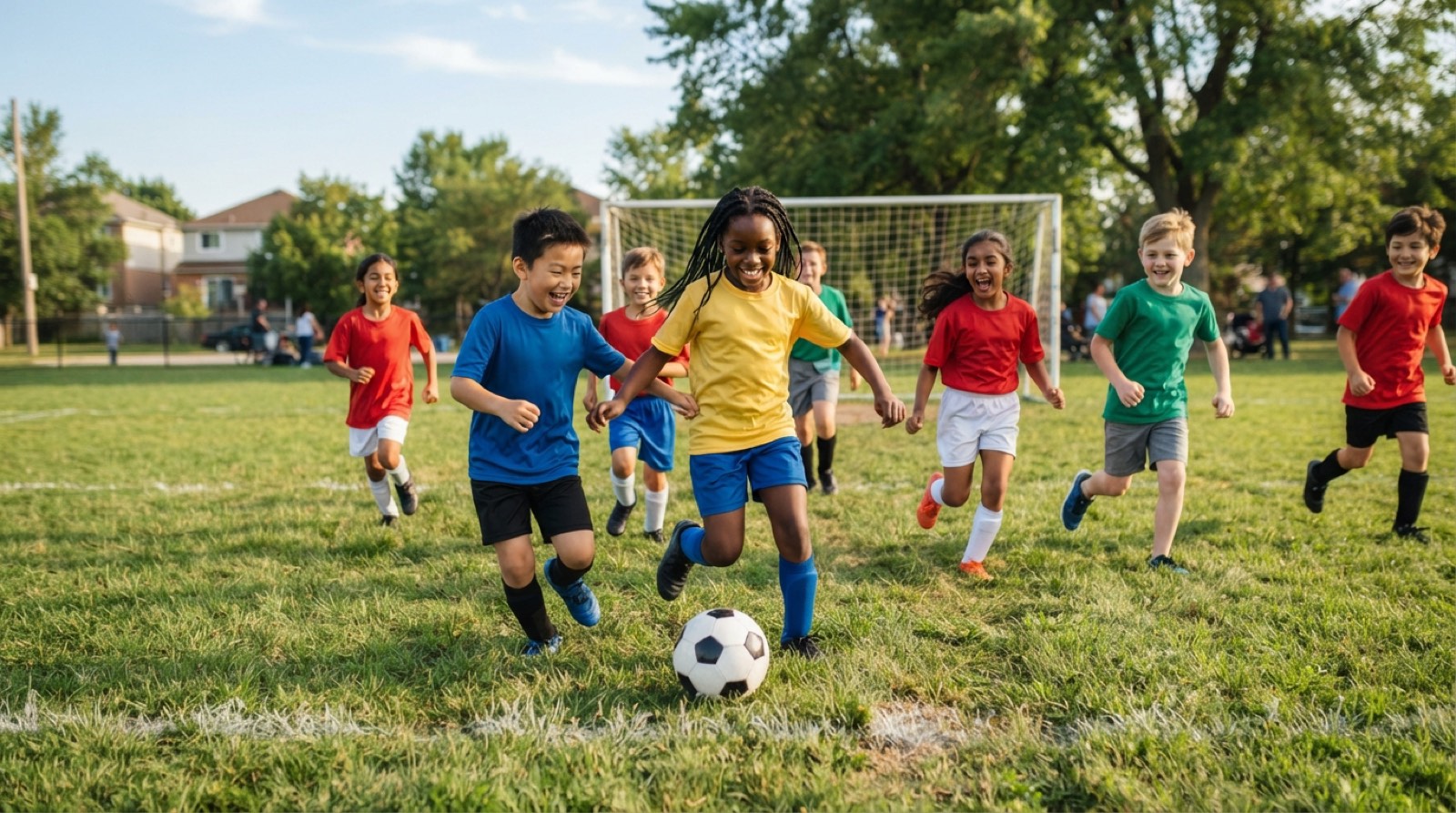
Parents often ask me what soccer actually does for a child besides keeping them busy after school. That is the right question.
After many years coaching in Temecula, my answer is still simple: soccer is one of the best all-around activities for kids because it trains the body, the brain, and the social side at the same time. The research backs up a lot of what coaches see every week.
Key takeaways
- Soccer helps kids reach the daily movement target many children miss.
- It builds aerobic fitness, coordination, bones, muscles, and healthy habits.
- Team-sport research links participation with lower anxiety, depression, and social problems.
- Soccer teaches confidence, teamwork, leadership, and resilience when coaching is healthy.
- The benefits last only if kids keep enjoying the game.
What are the real benefits of soccer for kids?
The real benefits of soccer for kids are physical fitness, coordination, stronger bones and muscles, better mood, friendships, teamwork, confidence, focus, leadership, and long-term active habits. Soccer works because children move constantly while solving problems with teammates. The benefits are strongest when the environment stays fun, safe, and age-appropriate.
Below are the 10 benefits I would want a parent to know before signing up.
1. Soccer helps kids hit the daily activity goal
Movement is the first benefit because most children do not get enough. The CDC recommends 60 minutes or more of daily activity for children ages 6-17, including vigorous activity and muscle- and bone-strengthening activity at least 3 days each week. CDC school-health data show that less than one-quarter, or 24%, of children ages 6-17 meet that daily target.
A soccer practice makes movement easier because the child is not counting minutes. They are chasing, passing, defending, shooting, and laughing. For busy Temecula families, that matters. A structured practice can turn the activity guideline into something your child actually wants to do.
2. Soccer builds aerobic fitness
Soccer builds aerobic fitness because players jog, sprint, recover, change direction, and repeat for long stretches of play. That kind of movement trains the heart and lungs in a way stop-start sports do not always match. Kids improve fitness while chasing the ball, not counting laps.
The Aspen Institute’s Healthy Sport Index ranked soccer among the most aerobically active team sports, with girls’ soccer at 4.23 MET and boys’ soccer at 4.05 MET, ahead of basketball, football, and baseball in that measure. That does not mean every child needs competitive soccer. It means the sport itself gives a strong fitness base.
| Benefit area | What soccer asks kids to do |
|---|---|
| Aerobic fitness | Jog, sprint, recover, repeat |
| Agility | Cut, turn, stop, restart |
| Balance | Control the ball while moving |
| Strength | Jump, shield, kick, accelerate |
| Coordination | Track the ball, teammates, and space |
If you are comparing sports, I break that down in Soccer vs. Basketball, Baseball & Football.
3. Soccer strengthens bones and muscles
Soccer strengthens bones and muscles because running, jumping, stopping, and changing direction load the body in healthy ways. The CDC activity guidelines say children need muscle- and bone-strengthening activity at least 3 days a week, and soccer naturally includes both in normal play.
This is one reason I like soccer for kids who do not enjoy traditional exercise. They build the same physical base through play. A child who would never choose laps may sprint 20 times in a game because the ball is there.
4. Soccer improves coordination and body control
Soccer improves coordination because it asks kids to move their whole body while controlling a ball with their feet. They must scan for space, avoid defenders, adjust to a bouncing ball, and keep balance under pressure. That creates constant practice in timing and body control.
For younger children, this matters because movement skills develop through repetition. A review on fundamental movement skills notes the early-childhood window around ages 3-6 as an important period for building skills such as running, jumping, kicking, and balance. Soccer gives those skills a fun home.
Parents of younger players should also read Toddler and Preschool Soccer and What Age Should Kids Start Soccer?.
5. Soccer supports mood and mental health
Soccer can support mood because team sport gives kids belonging, routine, movement, and shared goals. That combination can be powerful. A 2022 PLOS ONE study of 11,235 U.S. children found team-sport participation was associated with 19% lower withdrawn/depressed scores, 17% lower social problems, 12% lower attention problems, and 10% lower anxious/depressed scores compared with no sport.
That is an association, not proof that soccer cures anything. I would never tell a parent that sport replaces mental-health care. But I have seen anxious kids settle when they feel part of a team. The research gives that observation some weight.
6. Soccer builds friendships and belonging
A soccer team builds belonging by giving kids repeated chances to know other children by name, work through mistakes, and share wins and losses. That social rhythm matters, especially for kids who are shy, new to town, or unsure where they fit with a group.
The same PLOS ONE study found team-sport kids had 17% lower social-problem scores. Again, that does not prove team sport caused the difference. It does suggest that belonging in a healthy team environment is worth taking seriously.
On our fields, I watch this in small moments: a nervous player getting invited into a passing group, a teammate clapping after a miss, a child learning that they are needed.
7. Soccer teaches teamwork in a real way
Soccer teaches teamwork because no player can do everything alone. A child has to pass, cover, support, communicate, and sometimes do the unglamorous job that helps the team. That lesson lands better on a field than in a lecture because the game gives instant feedback.
I like soccer for this because the game gives quick feedback. If a player dribbles into three defenders every time, the game shows them why support matters. If they pass and move, the team improves. Kids learn cooperation because the ball teaches it.
8. Soccer grows confidence through progress
Soccer grows confidence by giving children visible proof that effort changes skill. A child tries a move, fails, works, improves, and realizes they can change. That loop happens every practice. Confidence is not a speech from an adult; it is evidence the child can feel.
I have seen beginners arrive afraid to touch the ball and leave a season later asking to play striker. I have seen quiet defenders learn to call teammates into position. That confidence is not about becoming the best player. It is about seeing effort turn into progress.
If your child is nervous, the right fit matters more than the level. Start with Youth Soccer in Temecula and choose a coach who builds kids, not just lineups.
9. Soccer can support school readiness and focus
Soccer can support school focus because active children often show better learning habits. The CDC reports physically active students tend to have better grades, attendance, cognitive performance, and classroom behavior. The same CDC page links higher physical activity and fitness with better concentration and memory.
I keep the claim honest: soccer will not magically raise grades. Homework, sleep, food, teachers, and family routines all matter. But regular movement helps a child show up more ready to learn. For some kids, a good practice is the pressure release that makes the evening calmer.
10. Soccer can build leadership
Soccer builds leadership in small, repeatable moments: calling for the ball, helping a teammate, owning a mistake, or staying calm after a goal against. Those are real reps. A child does not need a captain’s armband to practice leading; they need responsibility and trust.
The Women’s Sports Foundation’s 2024 research reported that 49% of women credit skills learned through sport for leadership development, and 71% of women in formal leadership roles said sport helped them get there. That is why I care about keeping girls and boys in the game long enough to feel those benefits.
Soccer does not build leadership by accident. Coaches have to give kids voice, responsibility, and room to solve problems.
The benefit parents forget: staying in the game
All 10 benefits depend on one thing: the child keeps playing long enough for soccer to shape habits. The Aspen Institute Project Play survey found the average child quits sports by age 11 after 2.86 years, and 36% said they quit because it stopped being fun.
That is why I push parents to choose the right level. A child does not need the hardest team on day one. They need the right coach, the right challenge, and a reason to come back. For some players that is recreational soccer. For others it becomes competitive soccer. The path should follow the child.
Bringing the benefits home in Temecula
If you are in Temecula, Murrieta, Menifee, Lake Elsinore, Wildomar, Winchester, or French Valley, the practical question is not whether soccer has benefits. It does. The question is where your child can get those benefits without being rushed, overmatched, or pushed into the wrong level.
Start with fit: age, confidence, schedule, and motivation. If your child is ready to try, a free evaluation gives you a simple first step. If they already play and want more touches, training can help without forcing a bigger team commitment too early.
Frequently asked questions
What are the biggest benefits of soccer for kids?
The biggest benefits are fitness, coordination, confidence, teamwork, emotional control, and friendships. Research also links youth team sports with lower mental-health difficulties. Soccer helps because kids move constantly, solve problems quickly, and learn to work with teammates toward a shared goal.
Does soccer help kids get enough exercise?
Yes. The CDC recommends 60 minutes of daily activity for children ages 6-17, and soccer practice can cover much of that in one session. Because soccer mixes jogging, sprinting, jumping, balance, and quick turns, it builds both fitness and movement skill.
Can soccer help a child's confidence?
Yes, when the coaching is healthy. Confidence grows from trying, failing, adjusting, and seeing progress. A shy child who learns to call for the ball or a beginner who finally controls a pass gets proof that effort works. That kind of confidence can travel beyond the field.
Is soccer better than other sports for kids?
Not always. The best sport is the one your child enjoys enough to keep playing. Soccer stands out because it is highly aerobic, easy to start, social, and skill-rich. For younger kids, I usually prefer soccer plus another sport instead of early single-sport specialization.
What age do kids get the most from soccer?
Most kids get the most from organized team soccer around age 6 and up, when they can follow directions and understand simple teamwork. Ages 3-5 still benefit from playful ball activities, but the goal should be movement and joy, not structured competition.