Youth Soccer Guide
Youth Soccer Coaching Licenses Explained (And Why They Matter)
When parents tour a soccer club, they usually ask about schedules, uniforms, and whether their child will make a team. Those questions matter. But one question belongs near the top: who is coaching my child, and what training do they actually have?
A license does not make a coach perfect. I have seen licensed coaches miss the human side, and I have seen volunteers care deeply. But education, SafeSport, and background checks give parents a real baseline. In youth soccer, that baseline matters.
Key takeaways
- The U.S. Soccer coaching path starts with Grassroots and moves through D, C, B, A, and Pro.
- US Club Soccer says Grassroots and D focus on grassroots players, C on U13-U17 participation, and B on U13+ or senior performance settings.
- SafeSport training and background checks should be part of any serious youth soccer environment.
- Project Play cites research showing only 5% of kids with trained coaches did not return, compared with 26% with untrained coaches.
- Parents should watch one practice before trusting any badge.
What are US soccer coaching licenses?
US soccer coaching licenses are formal coach-education levels that help adults teach the right game to the right age. The pathway begins with Grassroots courses, then moves through D, C, B, A, and Pro. For parents, the point is simple: a licensed coach has chosen to study coaching, not just run drills.
U.S. Soccer’s Learning Center is the home for the national coaching pathway. US Club Soccer also explains that the Coaching License Pathway builds level by level, with each course tied to the coach’s experience and player environment.
Do not treat a license as the only test. Treat it as the starting line. Then watch how the coach teaches.
The license ladder, in plain English
The license ladder moves from beginner youth environments to high-performance soccer, with each level adding more coach education and expectation. Parents do not need to memorize every prerequisite. You mainly need to know whether the coach’s education fits your child’s age, level, and needs.
| Level | Plain-English meaning | Best parent read |
|---|---|---|
| Grassroots | Entry-level courses tied to 4v4, 7v7, 9v9, and 11v11 | Good baseline for youth teams |
| D License | Deeper grassroots coaching education | Strong sign for developing players |
| C License | Participation environment, especially U13-U17 | Useful for older youth teams |
| B License | Performance environment for U13+ or senior teams | Serious training background |
| A License | Advanced coaching education | High-level youth or adult coaching |
| Pro License | Highest professional pathway | Usually professional environments |
US Club Soccer says the Grassroots game models and D License focus on the grassroots environment, the C License is designed for U13-U17 participation, and the B License prepares coaches for U13+ or senior performance settings.
Why licensing matters for young players
Licensing matters because children are not small adults. A good youth coach needs to know age-appropriate teaching, workload, safety, and communication. The wrong coach can make a talented child anxious. The right coach can make an average child love the game for years.
U.S. Soccer’s Player Development Initiatives scale the game by age: 4v4 for U6-U8, 7v7 for U9-U10, 9v9 for U11-U12, and 11v11 for U13 and older. Coach education should match that same idea.
A coach of 7-year-olds should not train them like a high school team. A coach of older competitive players should know how to build sessions, teach decisions, and manage pressure. The license pathway does not solve everything, but it pushes coaches to think that way.
SafeSport and background checks are not extras
SafeSport and background checks should be treated as baseline youth-sports protections, not bonus features. Parents should ask directly whether every adult working with players is cleared, trained, and monitored. If a club cannot answer plainly, that is a reason to slow down.
US Club Soccer lists Background Screening and SafeSport under its safeguarding and compliance resources, and its U.S. Soccer Education page points coaches to the national pathway. At SWSC, every coach is USSF-licensed and background-checked — that is the standard your family should expect anywhere.
No parent should feel awkward asking about child safety. I would rather answer that question again and again than have one family assume.
Trained coaches help kids stay in the game
Trained coaches help because they usually create clearer, safer, more age-appropriate environments for children. The benefit is not only better passing patterns. It is retention, confidence, and less burnout. Kids stay longer when the adult in charge teaches without fear.
The Aspen Institute’s Project Play cites research showing only 5% of kids with trained coaches did not return to a sport the next season, compared with 26% with untrained coaches. That gap should matter to every parent.
I have watched it on our fields. The best coaches correct mistakes without making the player feel small. They know when to push, when to pause, and when a child needs a simpler instruction. That is coaching. Running laps after every error is not.
If your child is showing stress, read Preventing Youth Sports Burnout. Coach fit is one of the first things I would check.
Questions to ask before joining a club
Ask direct questions about licenses, safety, communication, and player development before joining a club. A good coach or director will answer in plain language. If the answer turns into vague talk about winning, rankings, or exposure, bring the conversation back to your child.
Use this parent checklist:
| Parent question | What a good answer includes |
|---|---|
| What license do you hold? | A specific level and why it fits the team |
| Are adults background checked? | A clear yes and the process used |
| Is SafeSport required? | A clear yes for covered adults |
| How do you teach mistakes? | Correction without humiliation |
| How do you manage playing time? | A philosophy, not a shrug |
| How do you talk with parents? | A clear communication plan |
For more on choosing the right level, read Rec vs. Competitive Youth Soccer. If your family is still asking whether soccer fits your child at all, start with Is Soccer Good for Kids?.
Watch practice before you decide
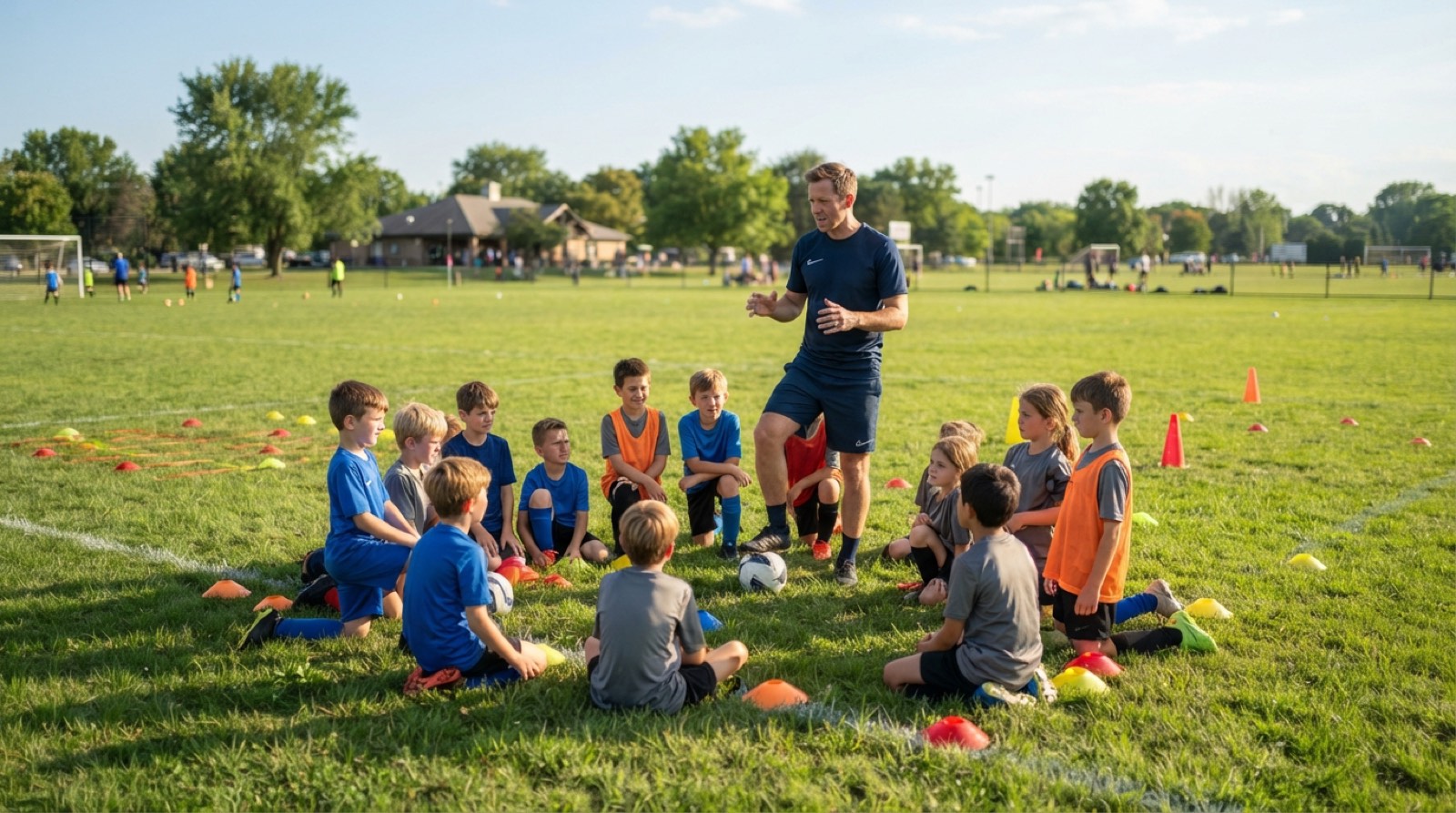
The fastest way to judge a coach is to watch practice. Look at the kids, not the cones. Are they active? Are they learning? Do they recover after mistakes? Does the coach teach the game, or just shout instructions from the sideline?
I would rather see a simple, well-run session than a complicated drill the coach cannot explain. Good youth training has movement, decisions, feedback, and joy. Players should know what they are working on. Parents should be able to see the purpose.
This is also where you catch culture. A coach can have a strong license and still create pressure. A club can have beautiful uniforms and still ignore development. Watch the field. The field tells the truth.
What this means in the Temecula Valley
For families in Temecula, Murrieta, Menifee, Lake Elsinore, Wildomar, and French Valley, the right coach is the one who fits your child’s age, level, and temperament. Licensing gives you a baseline. Safety checks protect the environment. Practice behavior tells you the rest.
At SWSC, licensed and background-checked coaching is part of the standard because youth soccer is too important to leave to guesswork. If you want to see where your child fits, start with a free evaluation. If they are ready for more, ask about competitive soccer or extra training. The coach matters as much as the team.
Frequently asked questions
What are US soccer coaching licenses?
US soccer coaching licenses are education levels on the U.S. Soccer pathway, starting with Grassroots and moving through D, C, B, A, and Pro. Each level adds more depth for the players and environment a coach serves. Parents should ask what license a coach holds and why it fits that team.
Does a youth soccer coach need a license?
Requirements vary by league and club, but a license is a strong sign that the coach has formal education. It does not guarantee a great coach, and an unlicensed volunteer can still care deeply. For competitive soccer, I would expect clear licensing, SafeSport training, and background checks.
What is the U.S. Soccer license pathway?
The pathway starts with Grassroots courses, then D, C, B, A, and Pro. [US Club Soccer](https://usclubsoccer.org/ussoccer-coach-education) says the Grassroots and D levels focus on the grassroots environment, C fits U13-U17 participation, and B prepares coaches for U13+ or senior performance settings.
What should parents ask a soccer coach?
Ask what license they hold, whether they are SafeSport trained and background checked, how they teach mistakes, and how they communicate with parents. Then watch a practice. The best answer is visible: kids are engaged, corrected clearly, and treated with respect.
Are licensed coaches better for preventing burnout?
Often, yes, because coach education helps adults teach by age and environment. Project Play cites research showing only [5% of kids with trained coaches did not return](https://projectplay.org/youth-sports/facts/challenges), compared with 26% for untrained coaches. Training is not everything, but it matters when pressure rises for kids during a season.