
Youth Soccer Guide
Is Soccer Good for Kids? An Evidence-Based Guide for Parents
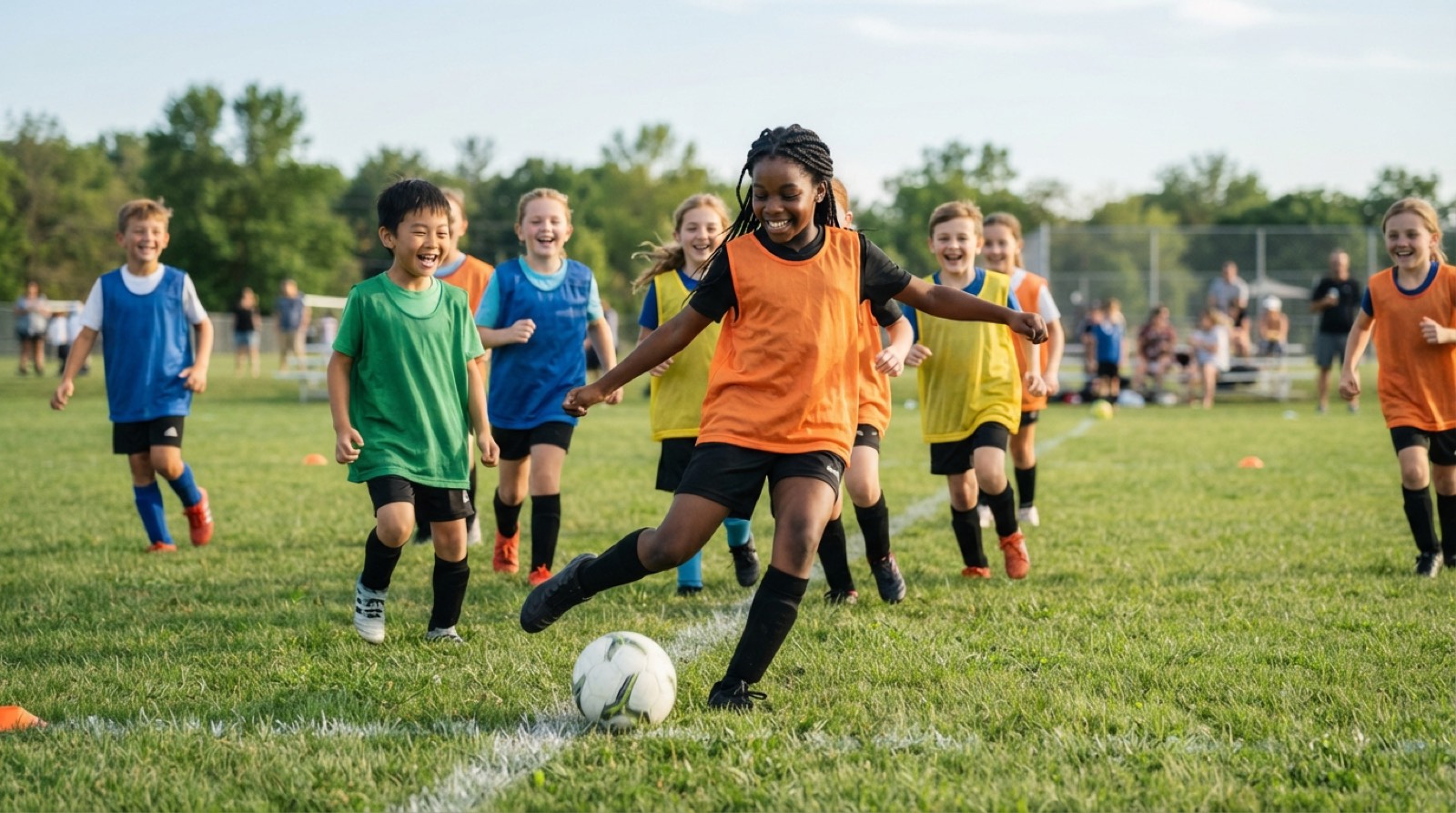
Every fall, a parent stands at the edge of our field in Temecula and asks me some version of the same question: is this actually good for my kid, or am I just signing up for weekend chaos?
Fair question. So here is the honest answer, backed by the research rather than a sales pitch. Soccer is one of the best all-around activities you can give a child — for the body, the brain, and the character — as long as it is coached well and kept fun. Below is what the evidence actually says, and where the real trade-offs are.
Key takeaways
- Kids need 60 minutes of activity a day, but fewer than 1 in 4 get it — an organized sport is one of the simplest fixes.
- Youth team-sport play is linked to meaningfully lower rates of anxiety, depression, and social problems.
- Soccer is among the most aerobically active youth sports and needs almost no gear to start.
- The safety risks are real but, in the words of the American Academy of Pediatrics, “largely preventable.”
- The biggest danger isn’t injury — it’s kids quitting sport entirely by age 11.
Is soccer good for kids?
Yes. Soccer gives a child steady aerobic exercise, teaches teamwork, and — according to a study of more than 11,000 U.S. children — is linked to lower rates of anxiety, depression, and social problems. It is also cheap to start and easy to play. The injury risks are mostly minor and, with good coaching, largely preventable.
The rest of this guide walks through each of those claims with the source behind it, so you can decide for your own family.
What an hour of soccer does for a child’s body
Movement is the headline benefit, because most kids simply don’t get enough of it. The Centers for Disease Control and Prevention recommends that children ages 6–17 get 60 minutes or more of moderate-to-vigorous activity every day, including muscle- and bone-strengthening activity at least three days a week. Yet CDC data show that fewer than one in four children actually hit that daily target.
A soccer practice knocks out that hour in one shot. And soccer is not a stand-around sport. In direct-observation research compiled by the Aspen Institute’s Healthy Sport Index, soccer scored as one of the most aerobically active team sports measured — ahead of basketball, football, and baseball. The World Health Organization links that kind of regular activity in kids to stronger hearts, healthier weight, better bone health, and improved mental well-being.
Here is the gap soccer helps close:
| Activity guideline (ages 6–17) | Reality |
|---|---|
| 60+ minutes of activity, every day (CDC) | Fewer than 1 in 4 kids meet it |
| Vigorous activity 3+ days a week (CDC) | One practice covers a day |
| Muscle- and bone-strengthening 3+ days (CDC) | Running, jumping, kicking build both |
Source: CDC, Physical Activity Guidelines for School-Aged Children and Adolescents (2024).
What soccer does for the mind and mood
This is the part that surprises parents most. Researchers analyzing data from the ABCD Study of over 11,000 U.S. children, published in PLOS ONE in 2022, found that kids who played team sports scored lower on a range of mental-health difficulties than kids who played none — including 19% lower withdrawn-depressed scores, 17% lower social problems, and 10% lower anxious-depressed scores.
One honest caveat: that same study found kids who only did individual sports scored slightly worse. The team environment — the shared goal, the teammates, the belonging — seems to be the active ingredient. It is also worth saying plainly that this is an association, not proof that soccer causes better mental health. But the direction is consistent across studies, and it matters at a time when Aspen’s Project Play reports that 42% of high school students feel persistent sadness or hopelessness — a figure drawn from CDC survey data.
| Mental-health measure | How team-sport kids compared |
|---|---|
| Withdrawn / depressed | 19% lower |
| Social problems | 17% lower |
| Thought problems | 17% lower |
| Attention problems | 12% lower |
| Anxious / depressed | 10% lower |
Source: Hoffmann et al., PLOS ONE (2022), ABCD Study, 11,235 children.
Soccer and the classroom
Parents often ask whether sports pull kids away from schoolwork. The evidence points the other way. The CDC reports that physically active students “tend to have better grades, school attendance, cognitive performance, and classroom behaviors.” Activity is tied to sharper concentration and memory — the exact tools a child uses to learn.
I want to be straight with you: the academic research is positive but mixed. A 2020 review in the British Journal of Sports Medicine found study designs vary and conclusions aren’t uniform. So don’t sign up expecting a report-card miracle. Think of it this way — an active, well-rested, socially connected kid shows up to class ready to learn. Soccer helps build that kid.
Life skills that outlast the season
Ask any parent what they really want, and it’s rarely “a better left foot.” It’s a kid who can handle setbacks, work with others, and lead. Sport is one of the few places children practice all three under a little pressure.
The Women’s Sports Foundation’s 2024 “Play to Lead” report found that 49% of women credit skills learned through sport for their leadership development, and 71% of those who reached formal leadership roles said sport helped get them there. The longer a girl plays, the more likely she is to lead. On our field, I watch this happen in miniature every week — the shy nine-year-old who spends a season learning to call for the ball is a different kid by spring.
Is soccer safe for kids?
Let’s not dodge this. Soccer has real injury risk, and I’d distrust any coach who told you otherwise.
The American Academy of Pediatrics reports that most youth soccer injuries come from player-to-player contact, and most are sprains, bruises, and the occasional fracture to the lower legs. Serious spinal or head trauma is rare. The AAP’s own word for these injuries is important: “largely preventable.”
Prevention is where a good club earns its fee. That means warm-up and neuromuscular training, coaches who enforce fair-play rules, and age-appropriate heading limits — U.S. Soccer bans heading in games for players 10 and under and limits it in practice through age 13. I won’t claim soccer is “the safest sport,” because the data don’t support a blanket statement like that (girls’ soccer, for instance, carries a genuine concussion risk worth respecting). What the data do support: the benefits are large, and the risks are manageable with the right coaching. If you’re weighing soccer against other options, my honest breakdown is in Soccer vs. Basketball, Baseball & Football.
The real risk: quitting too soon
Here is the statistic that keeps me up at night. According to an Aspen Institute Project Play survey, the average American child quits sports by age 11, after playing a given sport for less than three years. When kids ask why, the top answer is simple: it stopped being fun.
That’s the outcome I care about preventing. A child who stays active through their teens gets the physical, mental, and social benefits for a lifetime — not one season. The whole point of a supportive local club is to keep the game joyful long enough for those benefits to stick. Whether that means recreational or competitive soccer depends on your child, and I break down that choice in Rec vs. Competitive Youth Soccer.
Getting started in the Temecula Valley
If you’re in Temecula, Murrieta, Menifee, or Lake Elsinore and thinking about soccer, the best first step is low-stakes: let your child kick a ball around and see if they light up. When they’re ready for a team, look for a club with licensed, background-checked coaches and an emphasis on development over trophies.
Not sure your child is old enough? Start with What Age Should Kids Start Soccer? — it lays out exactly when kids are ready. And if you’d like a no-pressure look at where your child fits, that’s what our free evaluation is for.
Frequently asked questions
Is soccer good for kids?
Yes. Soccer gives children daily aerobic exercise, and research links youth team-sport play to lower rates of anxiety, depression, and social problems. It also builds teamwork, confidence, and discipline. The main risks — mostly sprains and contact injuries — are largely preventable with good coaching and age-appropriate rules.
What are the main benefits of soccer for children?
Soccer improves heart health, coordination, and bone strength; it is one of the most aerobically active youth sports. It also supports mental health, focus, and life skills like teamwork and resilience. Because it needs only a ball, shin guards, and cleats, it is an easy, low-cost sport to start.
Is soccer a safe sport for kids?
The American Academy of Pediatrics says most youth soccer injuries are sprains and contact bruises to the legs, and that they are largely preventable. Good clubs reduce risk with warm-up routines, fair-play rules, and age-appropriate heading limits — no heading in games for players 10 and under.
At what age can kids start playing soccer?
Most children are ready for organized team soccer around age 6, when they can follow directions and grasp teamwork. Before that, free play and simple ball games matter more than drills. Many clubs, including SWSC, run beginner sessions for younger children who want to start earlier.
Does playing soccer help kids in school?
Physically active children tend to have better focus, memory, and grades, according to the CDC. The research is positive but mixed, so soccer is not a guaranteed grade-booster. What is clear is that regular activity supports the brain functions — attention and memory — that help kids learn.